
Patent vs trade secret: benefits and drawbacks in different contexts
Patents and trade secrets are like two very different shields for protecting an invention. One is public + time-limited (patents), the other is private + potentially endless (trade secrets). Choosing between them isn’t just a legal decision—it’s a strategy call based on your invention, market, and business goals. Patent my idea will explore everything in this post.
Patent vs Trade Secret: Benefits and Drawbacks in Different Contexts
What is a Patent?
A patent is an exclusive right granted by the government that allows you to stop others from making, using, or selling your invention without permission.
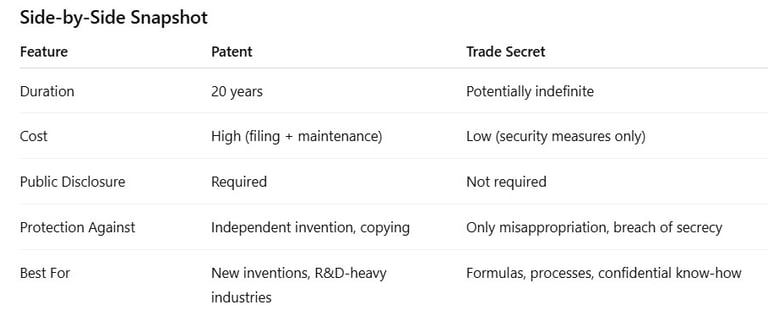
In India (and most countries), patents last 20 years from the filing date.
To get one, you must publicly disclose your invention in detail.
What is a Trade Secret?
A trade secret is confidential business information (formula, method, design, know-how) that gives a competitive advantage and is kept secret.
Protection lasts as long as secrecy is maintained (could be indefinite).
Famous example: Coca-Cola’s recipe, still a trade secret after 100+ years.
Benefits & Drawbacks of Patents
Benefits:
Strong, enforceable legal protection backed by the law.
Creates tangible IP assets—good for attracting investors or licensing.
Public disclosure helps establish your role as the inventor.
Drawbacks:
Expensive to file and maintain (especially internationally).
Limited term (20 years max).
Full disclosure means competitors can study your invention and design around it.
Benefits & Drawbacks of Trade Secrets
Benefits:
No registration cost (beyond security measures).
Can last forever if secrecy is maintained.
Covers things that can’t always be patented (e.g., customer lists, algorithms, processes).
Drawbacks:
No protection if someone independently invents the same thing.
If leaked, stolen, or reverse-engineered, protection is lost.
Enforcing rights in court can be harder than with patents.
Contexts: When to Choose Patents vs Trade Secrets
Pharmaceutical Industry
Patents: Critical—new drugs require disclosure but get 20 years of exclusivity.
Trade Secrets: Useful for manufacturing processes that aren’t obvious from the final drug.
Food & Beverages
Patents: Rarely used (recipes can be reverse-engineered).
Trade Secrets: Preferred—like Coca-Cola’s formula or KFC’s spice mix.
Software & Technology
Patents: Useful for core algorithms and hardware innovations.
Trade Secrets: Better for source code, machine learning models, and data sets.
Manufacturing Processes
Patents: Good if the process is novel and can be detected externally.
Trade Secrets: Ideal if the process is hidden inside a factory and hard to replicate.
Startups Seeking Funding
Patents: Valued by investors (patent portfolios increase valuation).
Trade Secrets: Harder to showcase as an “asset” unless tied to a strong brand or monopoly know-how.
Takeaway
Choose patents if your invention can be reverse-engineered, is highly innovative, or you need investor credibility.
Choose trade secrets if your advantage lies in processes, formulas, or data that can be kept confidential.
Often, the smartest companies use a hybrid approach—patenting core innovations while keeping other valuable know-how secret.